How to Know If Your Aircond Gas is Leaking: 6 Warning Signs
Learn the telltale signs of an aircond gas leak. Early detection can save you money and prevent compressor damage. Know what to look for.
How to Know If Your Aircond Gas is Leaking: 6 Warning Signs
You know the feeling—it’s 2 PM in Kuala Lumpur, the sun is blazing, and your air conditioner is running full blast but the room still feels like a sauna. Many homeowners in Puchong and KL immediately assume the gas is “finished” and call for a top-up.
But here is the reality most technicians won’t tell you: Aircond gas (refrigerant) is not fuel. It operates in a sealed loop and should never run out unless there is a physical hole in the system.
We have seen countless customers waste money topping up gas every three months without fixing the actual leak. This guide breaks down the exact warning signs, the hidden costs of ignoring them, and how to verify if your technician is actually solving the problem.
Sign #1: Gradual Decrease in Cooling Power
What you notice:
- The room takes 30-45 minutes to cool down instead of the usual 10.
- You constantly lower the remote setting to 16°C just to feel comfortable.
- The air blowing out feels “cool” but not cold.
Why it indicates a leak: Refrigerant is the medium that absorbs heat from your room. When the volume drops, the system loses its capacity to transfer that heat outside.
We use a simple diagnostic tool called the Delta T test to confirm this. A healthy unit should show a temperature difference of at least 8°C to 10°C between the air getting sucked in (room temp) and the air blowing out. If your unit is blowing air that is only 2-3°C cooler than the room, you are likely low on gas.
Sign #2: Ice Formation on Coils or Pipes
What you notice:
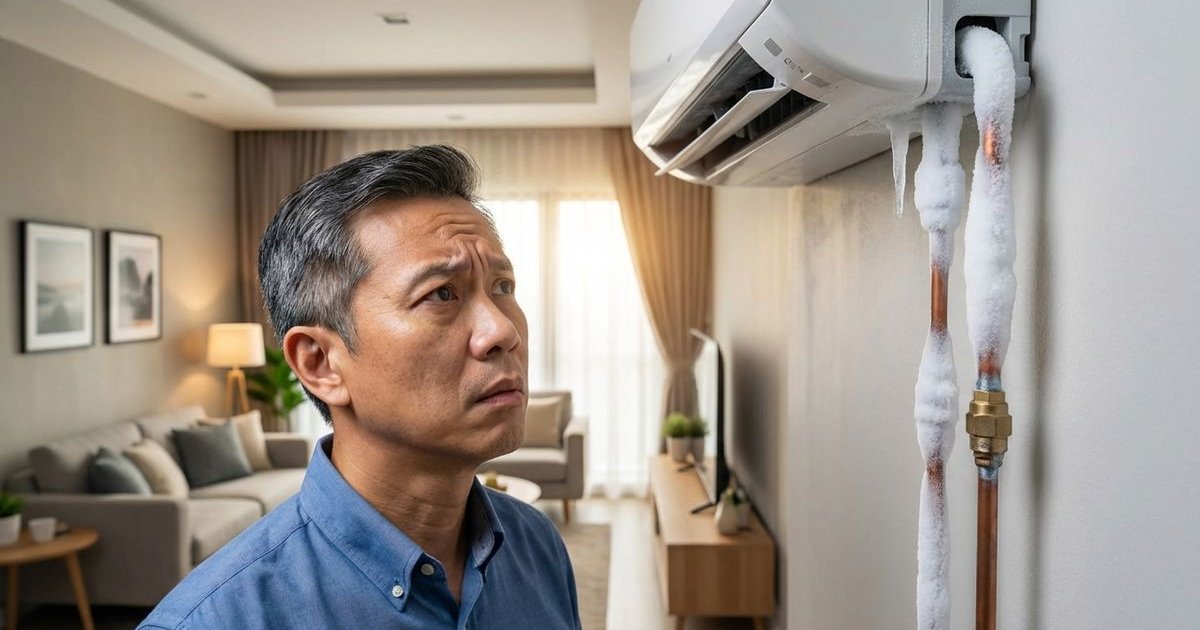
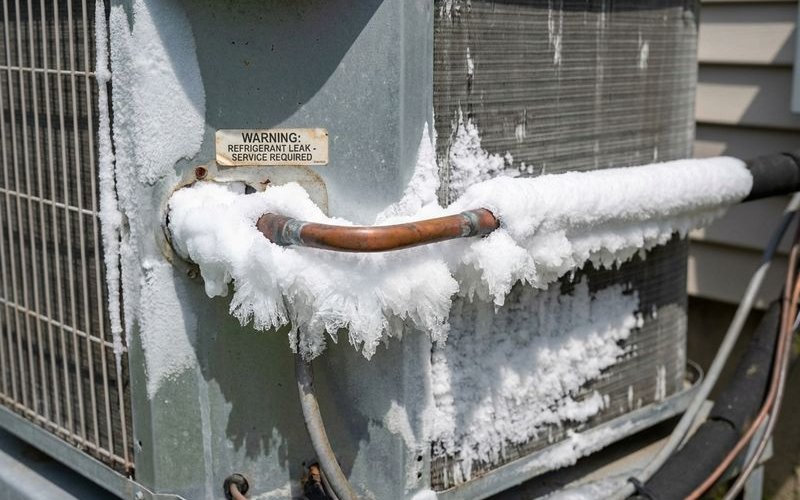
- White frost or thick ice accumulating on the copper pipes near the outdoor unit.
- Ice blocks forming on the indoor evaporator coil (behind the filter).
- Water suddenly leaking or “spitting” from the indoor unit when the ice melts.
Why it indicates a leak: Physics dictates that as pressure drops, temperature drops. When refrigerant leaks out, the pressure inside the copper pipes plummets, causing the remaining gas to boil at a temperature below freezing.
Malaysia’s high humidity makes this symptom appear very quickly. Moisture in the air hits these sub-zero pipes and instantly freezes. If you see ice, turn the unit off immediately. Running a frozen system is the fastest way to kill your compressor.
Sign #3: Hissing or Bubbling Sounds
What you notice:
- A faint “hissing” noise from the indoor unit (like a punctured tyre).
- Gurgling or bubbling sounds when the unit is running.
- The sound changes pitch or stops when the compressor cuts off.
Why it indicates a leak: A sharp hissing sound usually points to a significant, active leak where high-pressure gas is escaping rapidly.
Our technicians often find these leaks at the flare nuts—the connection points where the copper pipes meet the indoor or outdoor units. Bubbling sounds are slightly different; they typically indicate a slower leak where air bubbles are moving through the refrigerant lines, or where gas is escaping through a layer of oil.
Sign #4: A Sudden Spike in TNB Bills
What you notice:
- Your electricity bill jumps significantly without you changing your usage habits.
- The outdoor compressor never seems to stop running (it doesn’t “cut off”).
- You find yourself moving into a higher tariff block unexpectedly.
Why it indicates a leak: An air conditioner low on gas has to work overtime to reach your set temperature. In many cases, it never reaches it, causing the compressor to run 24/7.
This pushes your energy consumption into the penalty zones of Tenaga Nasional Berhad’s (TNB) tariff structure. Domestic usage below 200kWh is charged at roughly RM 0.218/kWh, but once you cross 300kWh or 600kWh due to an inefficient AC, the rate shoots up to RM 0.516/kWh or higher. You are essentially paying double for half the cooling.
Sign #5: Warm Air from Vents
What you notice:
- The air coming out feels barely different from a standard fan.
- The outdoor unit fan is spinning, but the compressor sounds different or is silent.
- The air is warm even after the unit has been running for an hour.
Why it indicates a leak: If the leak is severe, the system may be completely empty. Without refrigerant to absorb heat, the unit is just circulating room-temperature air.
Another possibility is that the compressor has overheated and triggered its thermal overload protection. Low gas means the compressor lacks the cool refrigerant vapor that usually keeps it from overheating. It shuts itself down to prevent a total burnout.
Sign #6: Oily Residue Near Connections
What you notice:
- Dark, wet spots on the white insulation tape wrapping the copper pipes.
- Oily stains on the floor directly below the pipe connections.
- Dust sticking to specific spots on the outdoor unit valves.
Why it indicates a leak: Refrigerant gas is mixed with a special oil to lubricate the compressor. When the gas leaks out, the oil often sprays out with it.
We always inspect the service valves on the outdoor unit first. If we see a grime-covered, oily patch on the brass connections, it is almost certainly the source of the leak. This is often caused by poor flare connections during the initial installation, a common issue with high-pressure R32 units.
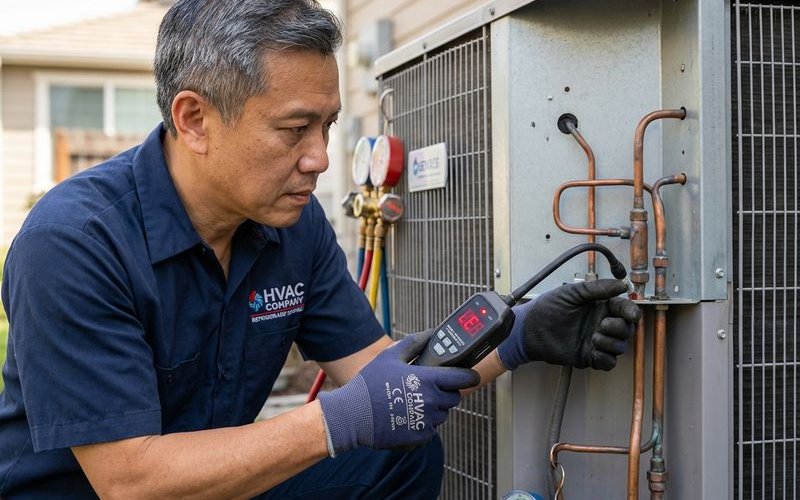
Common Leak Locations
Leaks rarely happen in the middle of a solid pipe. They almost always occur at weak points:
- Flare Nuts: The #1 culprit. If the installer didn’t use a torque wrench, these connections loosen over time due to vibration.
- Evaporator U-Bends: The U-shaped copper turns at the ends of your indoor coil.
- Service Valves: The ports where technicians connect their pressure gauges.
- Condenser Coils: The outdoor fins, which are exposed to rain, dog urine, or acidic cleaners.
Why Do Leaks Happen?
| Cause | The Technical Reality |
|---|---|
| Poor Installation | Incorrect flaring or not using a torque wrench creates weak joints that crack under R32 high pressure. |
| Formicary Corrosion | A chemical reaction (common in humid KL homes) creating microscopic pinholes in the copper coils. |
| Vibration | Constant vibration from an unbalanced fan can loosen mechanical connections over years. |
| Physical Damage | Accidental hits during renovation or aggressive chemical cleaning with acidic solutions. |
| Wear & Age | Rubber seals and O-rings degrade naturally after 10-12 years of service. |
What to Do If You Suspect a Leak
Don’t:
- ❌ Just keep topping up gas: You are throwing money away and harming the environment.
- ❌ Ignore the ice: Running an iced-up unit can bend the compressor valves.
- ❌ Accept “normal top-ups”: Be suspicious of any technician who says gas needs refilling “just for maintenance.”
Do:
- ✅ Shut it down: Turn off the power immediately if you see ice.
- ✅ Check the warranty: Daikin and Panasonic often have 5-year warranties on compressors but only 1 year on parts.
- ✅ Ask for a pressure test: Demand a nitrogen pressure test to confirm the leak location.
- ✅ Verify the repair: Ensure the technician uses a vacuum pump before refilling.
Professional Leak Detection Methods
We use different methods depending on the severity of the leak.
| Method | Best Used For | Accuracy |
|---|---|---|
| Electronic Sniffer | Finding small leaks in hard-to-reach areas. | High |
| Soap Bubble Test | Pinpointing the exact spot on accessible pipes/valves. | Medium |
| Nitrogen Pressure Test | Confirming if a leak exists in the piping loop. | Very High |
| UV Dye | Finding very slow, microscopic leaks over time. | High |
Cost of Ignoring a Leak (2025 Estimates)
Delaying a repair usually costs far more than fixing it immediately.
| Scenario | Consequence | Estimated Cost (KL/Selangor) |
|---|---|---|
| Keep topping up | Wasting money on gas every 3 months | RM 400 - RM 600 / year |
| Run with low gas | Compressor overheats and burns out | RM 900 - RM 1,800 |
| Ignore complete drain | Moisture enters system; requires overhaul | RM 500 - RM 1,000 |
Our Leak Detection Service
At AC Service Bro, we don’t believe in “band-aid” fixes.
Our team follows a strict protocol to ensure you aren’t calling us back in two months for the same problem:
- Visual Inspection: We check all flare nuts and visible piping for oil stains.
- Pressure Testing: We isolate the system to verify if it holds pressure.
- Proper Repair: We re-flare connections or braze leaks rather than just tightening a nut.
- Vacuum & Refill: We remove all moisture and air before recharging with fresh R32 or R410A gas.
- Warranty: We provide a warranty on our leak repairs because we stand by our workmanship.
Stop paying for gas top-ups that leak out in a week. Get the leak fixed permanently and enjoy reliable cooling.
Related Service
Learn more about our gas topup service